case study USSA Trade
gametheory scenarios

gametheory scenarios
Game theory has important applications in Economics and Business, because it helps users escape one-dimensional thinking and invites users to use dynamic programming and backward iteration to construct deals. I do this through Business School style case studies.
The US is South Africa’s most important trading partner. China is the largest, but the US is the most important because it has a high manufacturing component, and the terms of trade are balanced in our favor. Ironically, the whole deal was made in the Apartheid period. In typical ANC fashion, they have renamed it but done little to maintain or upgrade the infrastructure. It goes like this: The Eastern Cape (home to many Apartheid and ANC politicians) is one of the poorest areas, struggles to compete in free markets, and has high unemployment. In an infant industry deal, primarily with Mercedes and VW, 100,000 auto industry jobs have been created in Ghaberga and East London. A large part of the output ($1.9 Bn) is shipped to the US.
However, these jobs come at a high price of R 350,000 per worker or R 35 Bn per annum. This is equivalent to 10 million SRD grants of R 350! Disturbingly, the local component part (the infant industry part) under the ANC has not developed. Local components only make up around 30% of production. Nevertheless, renaming the whole process “AGOA” has provided Germany and China with a small but tariff-free opportunity to supply the US market through its nominee, South Africa. This works for SA, for without it, the Eastern Cape would rapidly deteriorate into a dust bowl, and East London would likely become a ghost town called Buffalo City. It works for the US because it sets up a balanced trade opportunity that gives SA the forex to buy US products.
Now we get to the bit about game theory. A US ambassador, who is a skilled negotiator at game theory, would look at the incoming Trump administration and analyze what are the “pain points” for Trump and his Secretary of State, Marco Rubio. They have wrongly or rightly analyzed that they have toxic trade relationships with everyone from Mexico and Canada to Europe and China. A tariff war is a likely outcome. The South Africa-US trade relationship may be small, may not be perfect, and may have Palestine, Iran, and BRICS squatting like a toad over it, but using dynamic programming and backward iteration, any skilled negotiator should have been the first to strike a deal with the new President. He would be able to market this as an example of success and use it in his bigger and more important negotiations.
That is what should happen if we had sent in a multi-dimensional thinker. That didn’t happen...
Instead, we sent in Rasool, a one-dimensional thinker who is more interested in the Palestinian narrative and has twentieth-century ideas about race relations.
The result?
Rasool is made persona non grata, and Rubio calls him a race-baiting hater that hates the US and hates the POTUS. Rasool sticks to his guns, has no regrets or cognizance of his incompetence, and talks about mythical San Francisco dockworkers voters who did not vote Trump into a landslide election win. That is why game theory is important and why anyone with any sense with property on the Nahoon River has already put it on the market before the renaming.
Believe me when I say I know Donald Trump – I know his type. He is Wharton Business School, disciple of Lawrence Klein. In the seventies and eighties Wharton was the leading quant school in the world. This is where econometrics and decision theory were incubated. For years I religiously followed their methods and very nearly went there myself. (ten years after Trump)
Trump is moving faster than the rest of us because he has already internalized game theory thinking. But he is predictable because Business people favor a market over a circus.
Let me see if I can bring you up to speed. To simplify a noisy relationship we simplify the model.
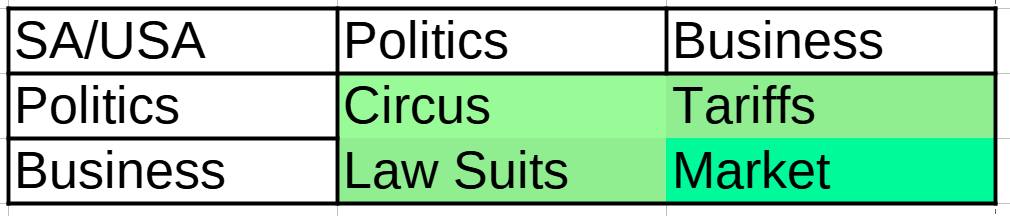
Two Player Model
South Africa/ US Trade
Each player has a trade-off, do they prefer Politics or Business? Simply by making the choice binary, it leaves us with four scenarios: Circus, Tariffs, Lawsuits, Market.
Other Party chooses
Now we have to calculate costs and opportunity costs on each scenario. This will help answer questions like: Is Leila Khaled Street worth a tariff of $500 Bn? Does South Africa have a role to play in International relations? What does America Want?
#gametheory
When playing game theory with Donald Trump, the advantages are clear. His moves are deliberate, his intentions telegraphed, and his bluffing minimal. You’re almost always the responder, reacting to his opening gambit.
In the arena of international trade, Trump’s play is the Optimal Tariff—a calculated move to improve U.S. economic welfare. It’s a strategy that demands decisions from the responder, including the option to do nothing.
Optimal Tariff theory, a cornerstone of international trade, posits that a tariff-imposing country can enhance its terms of trade and maximize economic welfare. A country uses its offer curve and trade indifference curve to rationally decide how much to tariff. The magic lies where the trade indifference curve of the home country kisses the offer curve of the foreign country—a delicate dance of economics understood by few.
But here’s the twist: contrary to media frenzy, imposing an optimal tariff isn’t about tit-for-tat rationality. Democratic lobbies can muddy the waters, dragging decisions into a circus of lawsuits, sanctions, and visa restrictions. And yet, amidst the chaos, opportunities emerge—especially for South Africa.
This defies the conventional wisdom that tariff wars leave everyone worse off. With careful management, a participant can win. Yes, win.
When the U.S. declares a tariff, it’s a declaration of business over politics. But in this two-player game, the responder holds the cards. Prioritize politics and drag the U.S. into a circus, or prioritize business and pull them into the market. The choice is now ours.
For South Africa, the battle lines are drawn at auto parts and tariffs. Our auto industry, a legacy of Apartheid, operates on subsidies—R35 billion from taxpayers offset by $1.9 billion in export U.S. sales. German manufacturers dominate, selling to themselves with our subsidies, financed by the U.S. Meanwhile, BRICS offers little in the way of export opportunities for autos.
Tariffs can never escape the stain, that they are a tax on the home country. In South Africa's case, if the current Auto tariffs are given no AGOA exemption, the cost to South Africa is around 15% of US exports, or about 15,000 subsidized jobs. Imported cars will get cheaper and may even be dumped on us.
And so, the game continues. The stakes are high, the players poised, and the opportunities ripe for those who dare to play. The BRICS countries offer us little to no export opportunities for autos.
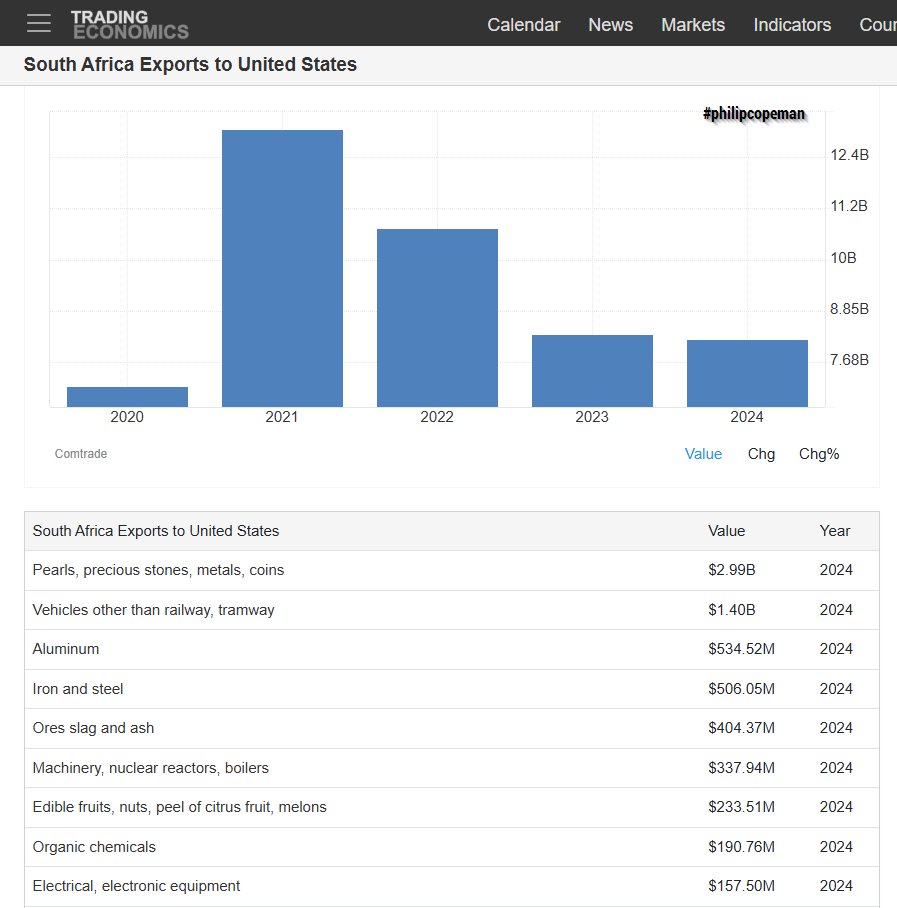
South Africa Exports to United States.
#philipcopeman
#gametheory

When you don your clown outfit, smear on the lipstick, grab a megaphone, and start ranting in public about US trade relations, here’s a tip: get the data first.
The US isn’t just another trading partner—it’s a critical one. Why? Because they buy from us a mix that includes manufactured goods, which have a far greater impact on employment than primary goods ever could.
Now, picture this: you’re wearing an orange wig, mocking the POTUS, and ignoring the numbers. Under the Biden Administration, South African exports to the US have fallen. But here’s the twist—Trump offers us a golden opportunity to double those exports.
Let’s break it down. When you rant against US trade relations, who are you really targeting? South African businesses. And somewhere down the list, you’ll find my personal favorite—Software. Yes, US SMEs actually buy TurboCASH Accounting. But when they see the circus act, it’s easy for them to confuse me with the clowns.
So, if you’re going to rant, make it count. Or, as the Germans say, “Nehmen Sie Platz, bitte.”
I met one of Trump’s Amerikaners last night.
“Why’d you do it? Why’d you do what you did?” I asked him, wondering what drives a man after we all know—because the guy in the red beret tells us - Afrikaners have it so good here in South Africa that they’ll never leave. So good, in fact, that we’ve had to legislate 144 laws to stop them from running away with the economy.
This guy (late twenties, maybe thirty at most) lives in Cape Town. Not a farmer—he’s in the harvesting business. Finished Agricultural College, but there were no local jobs. The Department of Agriculture and Rural Development? A quota for non-Afrikaners only. So, he financed a bakkie and started hustling fruit and veg. Western Cape farmers, city markets, buying and selling wholesale. Made R50K a month. Enough to feed a small family.
Last year, a Facebook ad found him. Midwest Harvesting Company couldn’t find harvester operators. Reluctant to leave his family, he held out—until they hounded him. He shut down his local business, flew to Texas, did a one-week course. Now he drives a harvester nineteen hours a day and pulls in over R150K monthly, earns what the DG earns at the Department. Flies back to Cape Town every month for family time and downtime drinks with strangers like me in bars.
Ever wondered why South Africa imports maize from the USA?
It’s about capital. Here, we worship labor intensity. An emergent farmer gets an allotment of stolen land, a bag of seed, and a priest’s prayers for rain. Ninety to 120 days later, sometimes, maize grows. Harvesting? Connected cadres bring in COSATU-backed workers earning slave wages—less than R5K a month—for a few weeks of grueling labor, followed by unemployment. They spend the rest of the year going to rallies, supporting Rasool’s race baiting.
In Texas, it’s different. Everything is automated. No unions. Fifty-one days from seed to harvest. Rotating teams of Amerikaners run the harvesters—machines that replace hundreds of laborers. While we wait another 70 days, the US producer bags the seed, exports it here. Got to stop that - we have jobs to protect! That’s where the expropriation and BEE rhetoric kick in to stem the flow.
Let me say it again: small-scale agriculture is a poverty trap.
Our young Amerikaner—must be happy, splitting his life between Texas and Cape Town, right? “No,” says he, ungrateful bugger. “Last week, while I was away, a gang broke into our house. Attacked my wife and kid at knifepoint. Stole our cash and toys. I’m taking them to America.”
“Good riddance,” says the guy in the red beret and breaks into song, "Kill the farmer, kill the Boer..."
#philipcopeman
#gametheory